Stair Terminology — essential definitions for architects & builders
Compact terminology overview: risers, treads, nosing, going, pitch line, headroom and more — with diagrams and dimension notes.
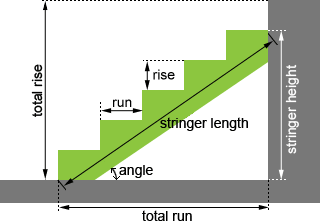
Core stair terms
- Riser
- The vertical part of a step. Typical indoor range is 150–200 mm; 120–140 mm is common in landscape steps.
- Tread
- The horizontal surface of the step. Comfortable residential range is typically 230–300 mm.
- Nosing
- Projection of the tread beyond the riser. Helps foot placement but is limited by code for safety.
- Going
- Distance from one nosing to the next — the effective tread depth used in formulas.
- Pitch line
- Line drawn through the nosings; used to determine angle and geometry.
- Total rise
- The full vertical height a stair must climb.
- Total run
- The total horizontal distance of the stair flight.
- Headroom
- Vertical clearance above a stair; usually 2.0–2.1 m minimum depending on jurisdiction.
- Ergonomic Rule
- 2 × rise + run ≈ 600–640 mm. Ensures comfortable movement.
- Angle / Pitch
- Typical comfort zone is 30°–37°; anything above 42° is generally unsafe.
Quick practical notes
- Indoor target: 150–180 mm riser, 250–280 mm tread.
- Check ergonomic formula and consistency.
- Useful tools: Stair Calculator and Slope Converter.
FAQ
- Is a 120 mm riser acceptable?
- Yes in landscape or public steps. Indoors typically 150–180 mm.
- What if I cannot meet the ergonomic formula?
- Adjust step count or run. Add a landing if space is restricted.